The shift to tokenized liquidity
By 2026, tokenized U.S. Treasuries have moved beyond experimental pilot programs into active corporate treasury management. The market has matured from niche interest to a functional component of digital asset portfolios, with the total market capitalization settling around $4.79 billion. This figure reflects a steady, albeit modest, daily change, indicating stability rather than speculative volatility.
The infrastructure supporting these assets has expanded significantly. Platforms like RWA.xyz now track distributed value exceeding $14 billion across various real-world assets, with tokenized Treasuries representing a substantial portion of that volume. For treasurers, the appeal lies in the combination of traditional government backing with the efficiency of blockchain settlement. The 7-day APY on these instruments hovers around 3.15%, offering a competitive yield that is accessible in real-time.
This shift marks a departure from the "digital gold" narrative of earlier years. Instead, tokenized Treasuries are being treated as operational liquidity. Corporations are using them to manage cash flow, settle cross-border payments, and provide transparent collateral in decentralized finance protocols. The transition from pilot to production demonstrates that the technology is reliable enough for serious financial stewardship.
How on-chain yields work
On-chain treasuries replace the traditional T+2 settlement cycle with near-instant, or T+0, finality. In a conventional corporate treasury setup, cash movement is slow; funds often sit idle in transit for days, losing potential yield and creating reconciliation headaches. On-chain, tokenized assets settle when the transaction confirms. This speed allows CFOs to deploy capital more aggressively, capturing yield from the moment funds are available rather than waiting for banking rails to clear.
The yield mechanics differ significantly from traditional money market funds (MMFs). While on-chain funds often track the same underlying short-dated US Treasury rates, the distribution method is automated via smart contracts. Instead of waiting for a monthly or quarterly dividend payment, yield accrues continuously and is reflected in the token’s value or distributed automatically. This transparency eliminates the lag between the asset earning interest and the investor seeing it.
For context, front-end yields on tokenized money market funds tracked roughly 4.0% to 4.5% through early 2026, closely mirroring short-dated US Treasury rates rather than speculative crypto returns [[src-serp-7]]. This efficiency means the treasury’s primary advantage is not higher interest rates, but the elimination of settlement friction and operational overhead.
Accounting and regulatory compliance
Tokenized treasury assets are not just a technological upgrade; they represent a fundamental shift in how corporate balance sheets are audited and reported. For CFOs, the transition from traditional banking rails to on-chain settlement introduces new accounting complexities, particularly around asset classification and revenue recognition. However, the underlying distributed ledger technology (DLT) offers a solution to the most persistent pain point in digital asset management: proof of reserves.
The Financial Accounting Standards Board (FASB) and the International Accounting Standards Board (IASB) have been working to align their standards for digital assets. The core challenge lies in distinguishing between digital assets held for sale versus those held for operational use. When a corporation holds tokenized U.S. Treasuries, the accounting treatment must reflect the underlying economic reality of the security, not just the digital wrapper. Recent updates to FASB standards aim to provide clearer guidance on fair value measurements, reducing the ambiguity that previously discouraged institutional adoption.
On-chain accounting simplifies this process through immutable audit trails. Unlike traditional custodial relationships where proof of reserves requires manual reconciliation and third-party attestations, tokenized assets allow for real-time, cryptographically verifiable ownership. Smart contracts can automate compliance reporting, ensuring that every transaction is recorded in a way that is instantly auditable. This transparency reduces the risk of fraud and lowers the cost of external audits, as auditors can verify holdings directly on the blockchain rather than relying on bank statements.
The market for tokenized Treasuries has grown to nearly $4.79 billion, reflecting increasing institutional confidence in these accounting frameworks. As standards mature, the distinction between "on-chain" and "off-chain" accounting is expected to blur, with on-chain verification becoming the gold standard for financial integrity.
On-chain vs traditional custody
Choosing between traditional banking custody and on-chain tokenized assets is less about technology and more about operational philosophy. The decision hinges on three core metrics: the cost of holding, the speed of access, and the distribution of risk. While traditional custody relies on established, albeit slow, intermediaries, on-chain treasuries leverage distributed ledger technology to streamline these processes.
Operational costs
Traditional custody involves multiple layers of intermediaries—prime brokers, custodians, and clearinghouses—each taking a cut. These fees accumulate, often ranging from 10 to 30 basis points annually, plus transaction costs for every trade or settlement. On-chain tokenized assets reduce this friction by automating settlement through smart contracts. This automation significantly lowers administrative overhead and eliminates many intermediary fees, making it a more cost-effective solution for large-scale treasury management.
Liquidity access
Accessing liquidity in traditional systems can take days, especially for cross-border transactions or complex asset classes. Settlement cycles (T+2 or longer) tie up capital and limit flexibility. On-chain treasuries operate 24/7 with near-instant settlement. This continuous liquidity allows CFOs to deploy capital more efficiently, responding to market opportunities or cash flow needs in real time without waiting for banking hours or settlement windows.
Counterparty risk
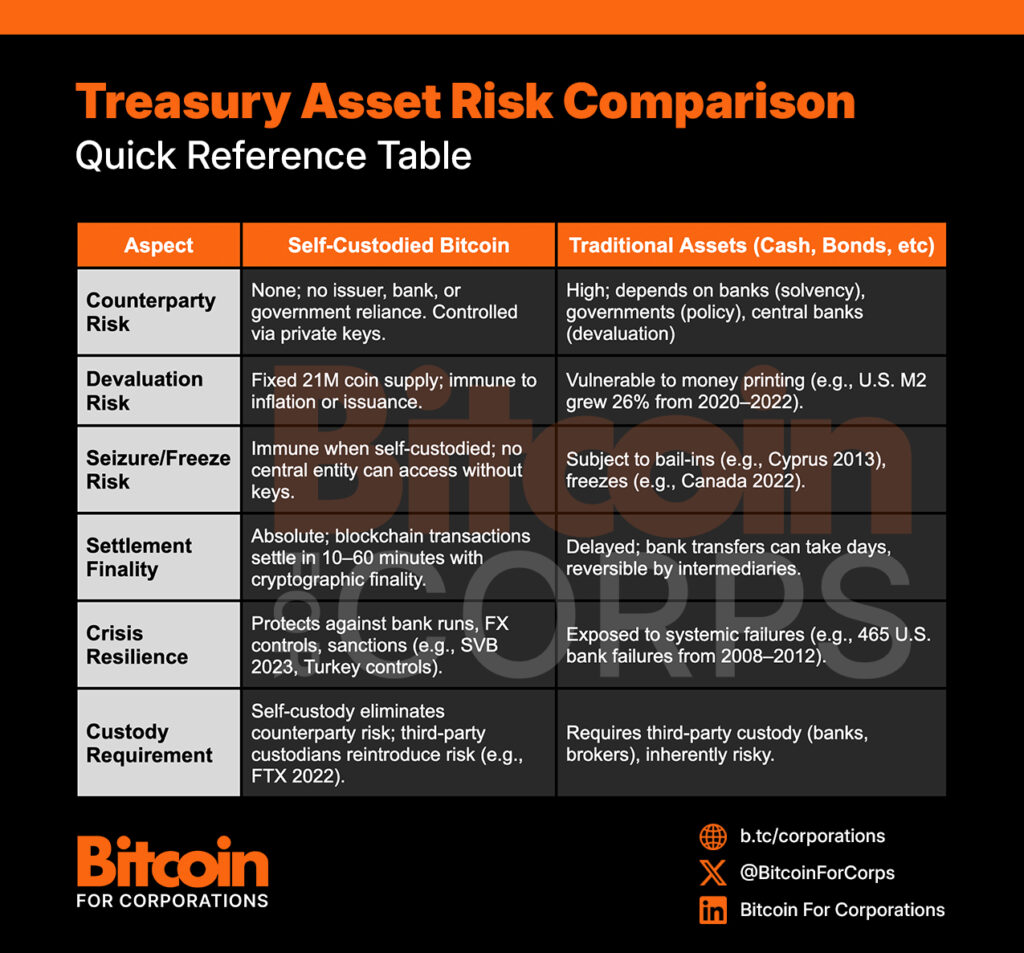
In traditional custody, risk is concentrated among a few large financial institutions. If one fails, the entire chain is disrupted. On-chain assets distribute this risk across a decentralized network. While smart contract risks exist, they are transparent and auditable. The tokenized treasury market cap, currently around $4.79 billion, reflects growing confidence in this distributed model. As noted by industry experts, the shift to digital assets offers a more resilient framework for corporate treasuries, reducing reliance on single points of failure.
| Metric | Traditional Custody | On-Chain Treasury |
|---|---|---|
| Settlement Time | T+2 or longer | Near-instant (24/7) |
| Operational Cost | High (multiple intermediaries) | Low (automated smart contracts) |
| Transparency | Opaque (batch reporting) | Real-time (on-chain ledger) |
| Counterparty Risk | Concentrated (few institutions) | Distributed (network-based) |
| Liquidity Access | Limited by banking hours | Continuous global access |
Implementation checklist for CFOs
Moving from strategy to execution requires a disciplined workflow. Before committing capital, CFOs must establish the legal, technical, and operational scaffolding for an on-chain treasury. This section outlines the five critical steps to launch a compliant and secure tokenized asset program.
Start by selecting the underlying asset class. Tokenized US Treasuries offer fractionalized access to short-dated government debt, providing yields that track closely with risk-free rates. Early 2026 data shows front-end yields on tokenized money market funds tracking 4.0% to 4.5%, offering a stable alternative to traditional bank deposits while maintaining on-chain liquidity [src-serp-7].
Not all wallets are created equal. Choose a custodian that provides multi-signature controls, institutional-grade insurance, and compliance with SOC 2 standards. The custodian acts as the bridge between your corporate bank account and the blockchain, ensuring that private keys are never exposed to daily operational risks.
Manual tracking does not scale. Your treasury management system must integrate directly with the blockchain via API to automate reconciliation. This ensures that your balance sheet reflects real-time on-chain positions, allowing for accurate financial reporting and audit trails without manual intervention.

Tokenized assets trigger specific tax events upon transfer or redemption. Work with legal counsel to define how on-chain transactions are reported for corporate tax purposes. Ensure your accounting software can handle the unique identifiers and timestamps associated with blockchain transactions to avoid discrepancies during audits.

Begin with a small allocation of non-core capital to test the workflow. This allows your team to identify technical bottlenecks and refine internal controls before scaling to significant portions of the corporate treasury. Monitor transaction costs, settlement times, and yield consistency closely during this phase.
Technical analysis of tokenized liquidity trends
Understanding the market dynamics of tokenized Treasuries requires examining both price action and volume metrics. The following chart illustrates the correlation between traditional Treasury yields and on-chain liquidity inflows, highlighting key support and resistance levels for institutional entry points.
Frequently asked: what to check next
What is the current market cap of tokenized Treasuries?
The tokenized Treasuries market cap is approximately $4.79 billion, reflecting a +0.02% daily change (Forbes). This figure represents the total value of tokenized U.S. government debt instruments, including Treasury bills, notes, and bonds, currently circulating on-chain.
How much is held in on-chain Treasury products?
On-chain Treasury products hold roughly $10.00 billion in total value, with a 7-day APY of 3.15% as of March 2026 (RWA.xyz). This segment is large and continues to grow as institutional and retail investors seek yield-bearing, compliant digital assets.
What are the US Treasury holdings in 2026?
Foreign Treasury Holdings in the United States averaged $6,826.87 billion from 2011 until 2026, reaching an all-time high of $9,487.10 billion in February 2026 and a record low of $4,912.10 billion in September 2011 (U.S. Department of the Treasury). This data provides context for the broader macroeconomic environment in which tokenized Treasuries operate.
No comments yet. Be the first to share your thoughts!