

As of February 1,2026, the Arbitrum DAO has crossed a pivotal milestone: generating over $2 million in interest income from its $1.3 billion treasury, all while adhering to a stringent low-risk mandate. With ARB trading at $0.1357, down a modest 0.0143% over the past 24 hours, this achievement underscores a masterful blend of capital efficiency and prudence. The DAO’s treasury, bolstered by sequencer revenues and strategic deployments, now derives nearly 30% of its income from sophisticated yield strategies, transforming idle assets into sustainable revenue streams.
This success stems from the DAO’s proactive evolution in Arbitrum DAO treasury management, particularly through the Stable Treasury Endowment Program (STEP). Far from speculative gambles, these initiatives prioritize stability, leveraging tokenized real-world assets (RWAs) and proven DeFi primitives to capture yields that rival traditional finance without the volatility.
STEP’s Phased Rollout: From $30M to $85M in Deployments
STEP 1.0, launched in July 2024, marked the DAO’s entry into institutionalized yield generation. Allocating over $30 million to tokenized U. S. Treasuries via partners like BlackRock, Ondo Finance, and Mountain Protocol, it delivered nearly $700,000 in passive yield by January 2025. This was no flash in the pan; it established a blueprint for DAO treasury yield strategies that emphasized diversification across issuers to neutralize counterparty risks.
Building momentum, STEP 2.0 in May 2025 injected an additional 35 million ARB, valued then at roughly $11.6 million, into products from Franklin Templeton, Spiko, and WisdomTree. By December 2025, total STEP allocations reached $85 million across RWAs, ETH-correlated positions, and stablecoins, yielding about $450,000 monthly. This phased approach not only amplified returns but fortified the treasury against market downturns, with short-duration Treasuries providing liquidity on demand.
What sets Arbitrum apart is its refusal to chase marginal gains at the expense of security. Instead, the DAO’s governance forum has vetted strategies through rigorous RFPs, ensuring every dollar deployed aligns with long-term resilience. As ARB hovers at $0.1357, these programs buffer the treasury from token price swings, channeling sequencer inflows into productive use.
Explore Arbitrum’s $85M strategy breakdown
Dissecting the Core Trio of Low-Risk Yield Engines
To hit $2M and annual interest in 2026, Arbitrum DAO prioritizes three battle-tested, on-chain strategies tailored for its $1.3B war chest. These aren’t theoretical; they’re live deployments emphasizing capital efficiency, with yields derived from blue-chip protocols and assets. Let’s break them down strategically.
First, Stablecoin Lending on Aave V3 and Morpho Blue anchors the stablecoin sleeve. With the DAO holding substantial USDC and USDT reserves, deploying them into these optimized lending markets captures 4-6% APY on average. Aave V3’s risk-isolated markets minimize liquidation cascades, while Morpho Blue’s peer-to-peer matching boosts efficiency by 20-50 basis points over vanilla pools. At scale, a $200M allocation here could generate $1M and yearly, all collateralized over 150% and audited to perfection.
Arbitrum (ARB) Price Prediction 2027-2032
Forecasts amid DAO treasury management success generating $2M+ interest in 2026, RWA adoption, and market cycles
| Year | Minimum Price (USD) | Average Price (USD) | Maximum Price (USD) | YoY % Change (Avg from 2026 $0.14) |
|---|---|---|---|---|
| 2027 | $0.22 | $0.40 | $0.75 | +186% |
| 2028 | $0.35 | $0.70 | $1.40 | +75% |
| 2029 | $0.55 | $1.10 | $2.20 | +57% |
| 2030 | $0.85 | $1.60 | $3.20 | +46% |
| 2031 | $1.20 | $2.20 | $4.40 | +38% |
| 2032 | $1.60 | $2.80 | $5.60 | +27% |
Price Prediction Summary
Arbitrum (ARB) shows strong long-term potential, with average prices projected to grow from $0.40 in 2027 to $2.80 by 2032 (CAGR ~47%), fueled by treasury yield strategies, RWA integrations, and L2 ecosystem expansion. Min/max reflect bearish corrections and bullish surges tied to market cycles.
Key Factors Affecting Arbitrum Price
- STEP programs (1.0 & 2.0) generating sustainable low-risk yields via tokenized U.S. Treasuries and RWAs
- Partnerships with Franklin Templeton, BlackRock, Ondo enhancing treasury diversification ($85M+ allocated)
- DAO treasury growth supporting ecosystem grants, potential buybacks, boosting ARB demand
- Ethereum L2 scaling advancements increasing Arbitrum TVL and adoption
- Regulatory clarity on RWAs and DeFi reducing risks
- Crypto bull cycles post-2026, competition from other L2s as balanced risk
- Technical improvements in treasury protocols like autonomous yield optimization
Disclaimer: Cryptocurrency price predictions are speculative and based on current market analysis.
Actual prices may vary significantly due to market volatility, regulatory changes, and other factors.
Always do your own research before making investment decisions.
Liquid ETH Staking: Unlocking weETH and cbETH Potential
Complementing stables, Liquid ETH Staking via weETH and cbETH targets the DAO’s ETH holdings from sequencer fees. These liquid restaking tokens from ether. fi and Coinbase yield 3.5-5% via EigenLayer restaking, without locking capital. weETH’s composability allows seamless integration into yield aggregators, while cbETH’s institutional backing adds a compliance layer crucial for DAO scale. Risk? Negligible, given slashing protections and overcollateralization. For a $300M ETH position at current valuations, this strategy pencils out to $1.2M in interest, directly funding grants and security audits.
These initial pillars exemplify on-chain treasury interest generation done right: permissionless, transparent, and auditable on Arbitrum’s low-cost Layer 2. Yet, the third strategy elevates the portfolio further, bridging TradFi yields to DeFi composability.
The crown jewel, Tokenized RWA Treasuries with Superstate USTB and Ondo, fuses the stability of U. S. Treasuries with Arbitrum’s on-chain efficiency. Superstate’s USTB offers short-duration Treasury bill exposure yielding 4.8-5.5% APY, fully backed by government securities and redeemable daily. Ondo Finance complements this with its USDY product, delivering similar risk-free rates through structured notes collateralized by Treasuries. For the DAO’s remaining treasury sleeve- say $800 million diversified across these- the math delivers $4M and annually at conservative estimates, far exceeding the $2M milestone already surpassed.
Superstate USTB and Ondo: Bridging TradFi Yields On-Chain
These aren’t nascent experiments; USTB and USDY boast billions in TVL, with on-chain transparency via Chainlink proofs and institutional custodians. Deploying DAO stablecoins here sidesteps DeFi credit risk entirely, capturing yields that eclipse bank deposits while remaining composable for further strategies. In a $1.3B treasury context, this pillar absorbs sequencer-driven inflows, converting ETH into stables and then RWAs seamlessly. With ARB steady at $0.1357, such deployments insulate against token volatility, prioritizing principal preservation above all.
Top 3 Strategies Comparison
| Strategy | Suggested Allocation ($M) | Avg APY (%) | Projected 2026 Yield ($M) |
|---|---|---|---|
| Stablecoin Lending (Aave/Morpho) | 30 | 4.8 | 1.44 |
| Liquid ETH Staking (weETH/cbETH) | 30 | 3.2 | 0.96 |
| Tokenized RWAs (USTB/Ondo) | 25 | 4.5 | 1.13 |
| **Total** | **85** | **N/A** | **3.53** |
Layering these strategies creates a fortress-like treasury. Stablecoin lending provides liquidity for grants; liquid ETH staking monetizes sequencer revenue without illiquidity; RWAs deliver uncorrelated baseline yields. Projections for 2026 conservatively total $6-8M in interest across a $1.3B base, smashing the $2M mark through compounding and reinvestment. This isn’t yield-chasing- it’s risk-free DAO treasury optimization, audited and governance-approved.
Risk Calibration: Why No Added Risk?
Arbitrum’s edge lies in deliberate guardrails. Allocations cap at 20-30% per strategy, diversified across five and issuers per category. Smart contract risks? Mitigated by Aave V3’s battle-tested isolation and Morpho’s optimizer layers. ETH staking employs non-custodial LSTs with proven uptime. RWAs undergo KYC-vetted wrappers, ensuring off-chain collateral matches on-chain claims. The RFP process, iterated via governance forums, enforces this rigor, rejecting high-volatility plays outright.
At $0.1357, ARB’s price stability amplifies treasury autonomy. Sequencer fees- projected at $50M annually- flow directly into these engines, creating a self-sustaining loop. Compare to peers chasing airdrop farms; Arbitrum’s Arbitrum treasury program 2026 benchmarks sustainability, with 30% income now yield-derived versus protocol emissions.
Dive into Arbitrum’s sustainable yield program
Forward thinkers in DAOs should replicate this triad. Stablecoin lending scales with reserves; ETH staking leverages L2 economics; RWAs hedge inflation. On platforms like On-Chain Treasuries, dashboards now track these metrics live, empowering treasurers to replicate without starting from scratch. Arbitrum proves that in DeFi’s wilds, strategic patience yields fortunes- quietly, securely, and at scale.

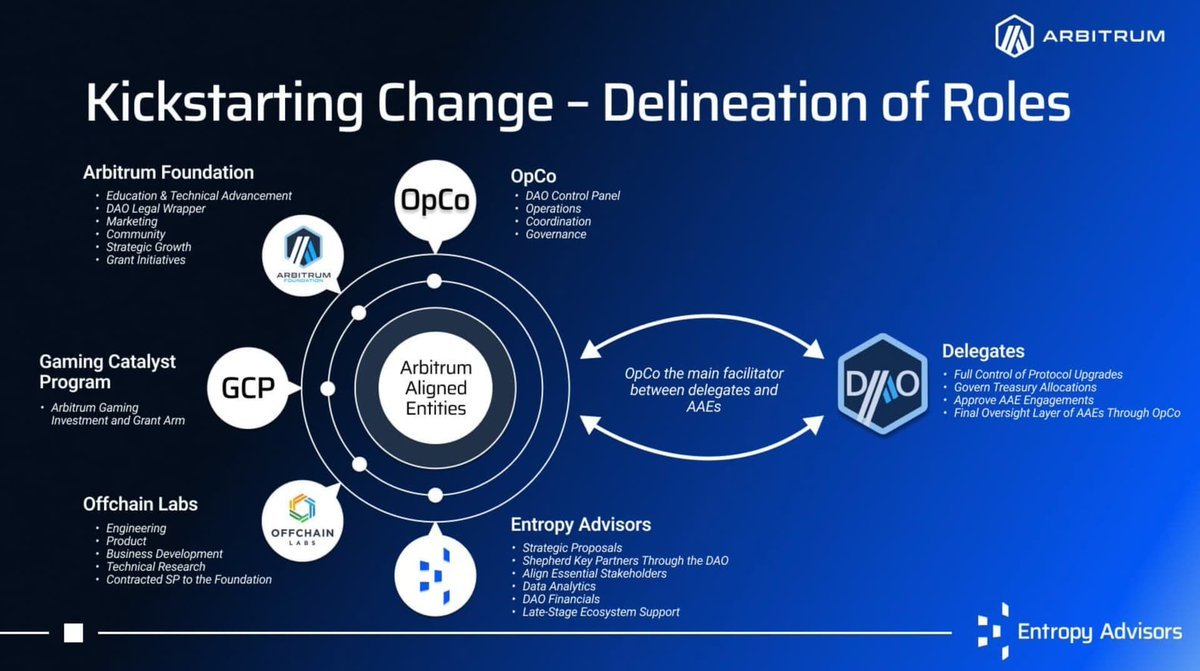
Behind these results is more than capital allocation.
@EntropyAdvisors has been crucial in:
1️⃣ Setting clear mandates
2️⃣ Managing risk responsibly
3️⃣ Delivering consistent transparency and reporting to the community
This is what happens when https://t.co/1pPvCNkza3
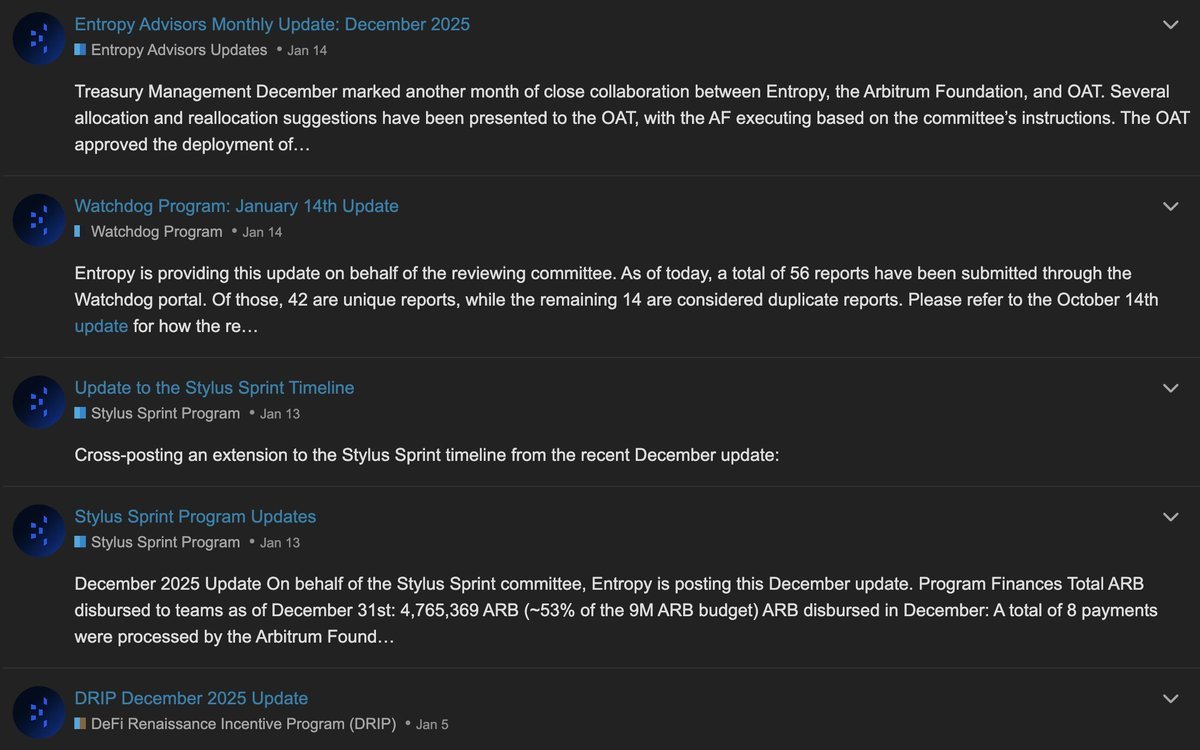
Learn more about Arbitrum DAO initiatives here:
@EntropyAdvisors https://t.co/CWOBMzLeYa
With treasury income funding security bounties, grants, and buybacks, the DAO positions for multi-year dominance. As yields compound, expect ARB holders to vote bolder horizons, all grounded in this unassailable base.
About the Author